PRL per PH/s: why your earnings differ from the calculator
How Pearl's PRL per PH/s per day is worked out, why explorers and calculators show different numbers, and why your own pool pays more or less: fees, luck, pool switches and a network that grew over 70% in October.
"PRL per PH/s per day" is the number every Pearl miner checks. But two sites rarely show the same figure, and your pool may pay noticeably more or less than either. Here is where the number comes from and why it moves, with the network's figures from 31 October 2026.
How the number is worked out
The whole network shares the same daily pot of new PRL:
PRL per PH/s per day = block reward × blocks per day ÷ network hashrate
On 31 October:
- Block reward: about 2,206 PRL
- Blocks per day: about 480 (one every 180 seconds on average)
- New PRL per day: about 1.06 million
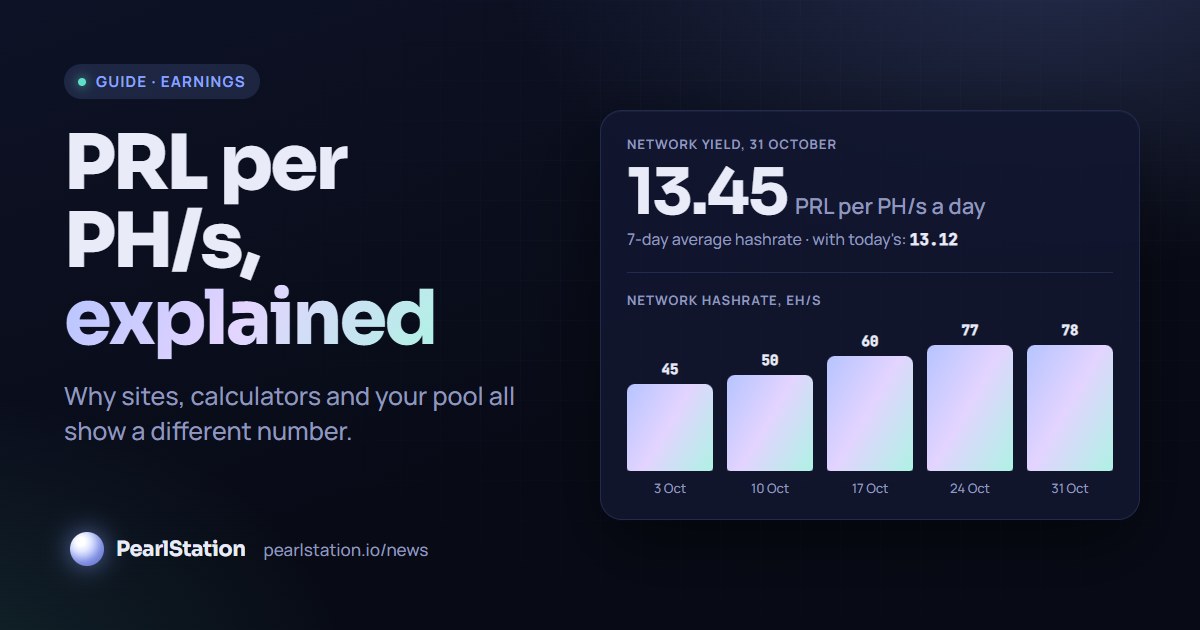
- Network hashrate: 78.8 EH/s on average over the last 7 days, 80.8 EH/s right now
That gives 13.45 PRL per PH/s per day with the 7-day average, or 13.12 with today's hashrate. That is before your pool's fee.
Why sites show different numbers
- Which hashrate. Today's hashrate or an average. While the network grows, today's figure gives a lower number. PearlStation uses the 7-day average, so one busy day does not swing it.
- Which block time. Some use the 3-minute target, others the real average. More blocks per day means more PRL per PH/s.
- Fee or no fee. Some show the network rate, others subtract a pool fee.
None of these is wrong. Just compare like with like.
Why it keeps falling
The network grew from about 45 EH/s at the start of October to about 78 EH/s at the end (daily averages), more than 70% in four weeks. The PRL per day stays the same, so the same PH/s earns less: the October average was about 16.8 PRL per PH/s, the last week about 13.5. A calculator that projects a year ahead should assume this continues. PearlStation's calculator has a "Difficulty growth" field for exactly that.
Why your pool pays more or less
Even at the same hashrate, your real yield can differ from the network rate:
- The pool fee. 0% to 3% on Pearl's pools.
- Luck. PPS and PPS+ pools pay the same for every share. PROP and PPLNS pools pay from the blocks they find, so a day can be 30% above or below. Judge those over a week or a month, not one day.
- Switching pools. On PPLNS, the first hours on a new pool pay less, because your shares are not yet in its window. Your old pool keeps paying a little for a while. Look at both pools together on that day.
- Stale and rejected shares. Every rejected share is work you are not paid for. A bad connection or an old miner version shows up here.
- The pool's hashrate vs your miner's. Pools measure your hashrate from the shares they accept. Count from that, not from what your miner prints.
An earlier version of PearlStation fell into one of these traps itself: it divided a week of rewards by one day of hashrate, so anyone who had just switched pools saw a far too low number. Since version 0.4.9 it compares rewards and hashrate from the same hours.
How to check your own
- Earnings shows your real PRL per PH/s, next to what the network paid.
- The pool report card on the same page compares every pool you mine on with what it should pay after its fee, recently and, with Pro, over 7 and 30 days.
- With Pro, a Telegram alert tells you when a day pays well below what the network paid for your hashrate.
On a PPS pool you should land within a few percent of the network rate after the fee. If you are much lower for several days in a row, check your rejected shares and your miner version first.