Pearl FP8 fork (PIP-3): will your GPU still mine PRL?
PIP-3 moves Pearl mining from INT8 to FP8 and names only NVIDIA Hopper and Blackwell. What it means for your graphics card, and what is known so far.
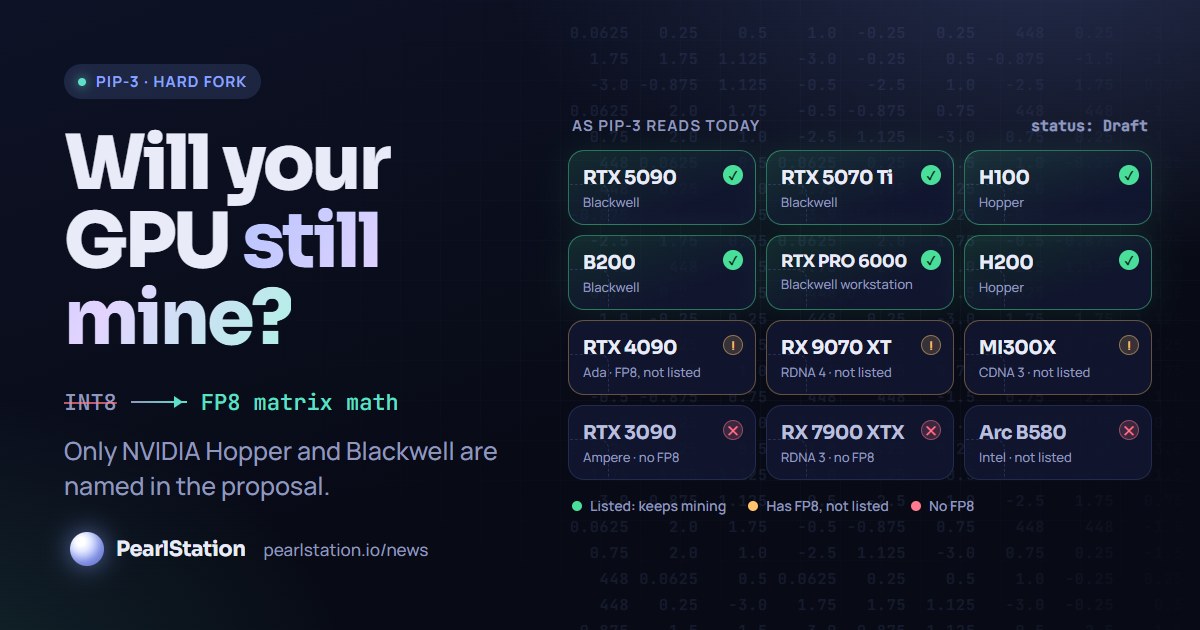
Pearl is planning its biggest change since launch. PIP-3, the proposal called FP PoUW Certificates, moves Pearl mining from INT8 to FP8 matrix math. As the proposal is written today, only two GPU architectures can mine after the fork: NVIDIA Hopper and NVIDIA Blackwell. Every other card stops mining Pearl at the activation height.
This guide explains what PIP-3 changes, where it stands right now, and how to check your own card.
The short answer
- Nothing changes yet. PIP-3 is a Draft, and it has no activation height. Until that height is reached, every card that mines Pearl today keeps mining.
- RTX 50 series, RTX PRO Blackwell, B200/B300, H100/H200: listed in PIP-3. They can keep mining after the fork, once the miners release FP8 versions.
- RTX 40 series, RTX 30 series, AMD and Intel cards: not listed. As written, they stop mining Pearl at the fork.
Check any card in seconds with the GPU checker in PearlStation.
What PIP-3 changes
Pearl uses proof of useful work: miners do matrix multiplications, the same math that trains and runs AI models, and prove it with a certificate in each block. Today those multiplications use 8-bit integers (INT8). PIP-3 switches them to 8-bit floating point (FP8), the format modern AI hardware is built around.
It is a hard fork. After the activation height, only certificate version 3 is valid, and it has to be computed on the hardware the proposal names. The proposal whitelists two NVIDIA architectures: Hopper and Blackwell.
Which GPUs are listed
| Group | Cards | After the fork, as written |
|---|---|---|
| NVIDIA Blackwell (GeForce) | RTX 5090, 5080, 5070 Ti, 5070, 5060 Ti, 5060, 5050 | Listed: keeps mining |
| NVIDIA Blackwell (workstation, data center) | RTX PRO 6000/5000/4500/4000 Blackwell, DGX Spark, B200, B300, GB200, GB300 | Listed: keeps mining |
| NVIDIA Hopper | H100, H200, H800, H20, GH200 | Listed: keeps mining |
| NVIDIA Ada Lovelace | RTX 4090, 4080, 4070, 4060, RTX 6000 Ada, L40S, L40, L4 | FP8 in hardware, but not listed: stops |
| AMD Instinct MI300, RDNA 4 | MI300X, MI325X, MI350X, RX 9070 XT, RX 9070, RX 9060 XT | FP8 in hardware, but not listed: stops |
| NVIDIA Ampere and older | RTX 3090, 3080, 3070, 3060, A100, CMP, RTX 20, GTX 16 | No FP8 in hardware: stops |
| AMD RDNA 3 and older, Intel Arc | RX 7900 XTX, RX 6800 XT, Arc B580, Arc A770 | Not listed: stops |
The full list, model by model, is in the GPU checker.
The RTX 4090 question
The RTX 40 series has FP8 units in hardware, so many miners expect it to keep working. PIP-3 does not list the Ada Lovelace architecture, though. If the proposal is activated as it reads today, an RTX 4090 stops mining Pearl at the fork, just like a 3090. This is the part of PIP-3 most worth watching while it is still a Draft.
Where PIP-3 stands
- Published as a Draft on 30 July 2026. This is where it is today.
- An activation height is written into the proposal.
- A node release carries the fork; pools and miners publish FP8 versions.
- The activation height is reached: only version 3 certificates are valid.
There is no date yet. A hard fork needs a node release well before the activation height so that pools, exchanges and miners can update. You will see step 2 and step 3 long before the fork happens.
What to do now
- Keep mining. Nothing changes until the activation height.
- Think twice before buying non-Blackwell hardware just for Pearl. As written, only Hopper and Blackwell are listed.
- Watch the proposal. PearlStation checks PIP-3 every 30 minutes. When it gets an activation height, it shows on the fork tracker, and we will post about it here. Questions? Ask in our Telegram group.
Sources
This guide follows the text of PIP-3 as of 22 October 2026. A Draft can still change; we will update this page when it does.